
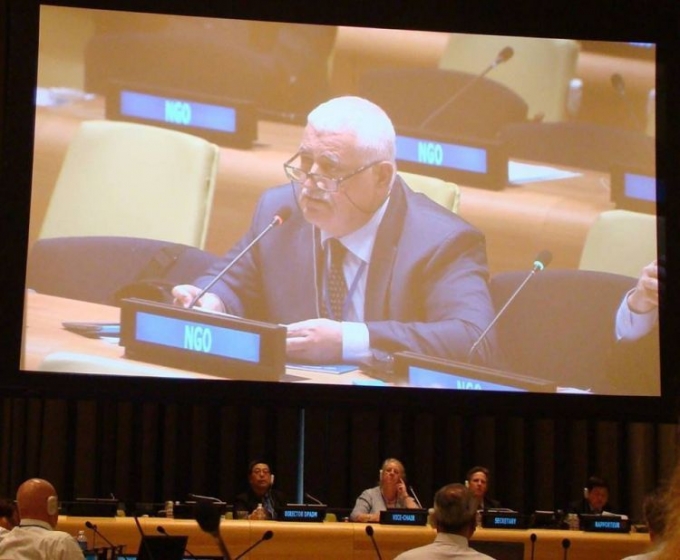
President of the International Eurasia Press Fund (IEPF) Umud Mirzaev addressed to Andrew Andersen, Executive Director of the «Front Line Defenders», the organization founded in Dublin in 2001 with the specific aim of protecting human rights defenders at risk (HRDs), people who work, non-violently, for any or all of the rights enshrined in the Universal Declaration of Human Rights (UDHR). Front Line Defenders addresses the protection needs identified by HRDs themselves.
Front Line Defenders maintains its headquarters in Dublin, an EU Office in Brussels, and regionally-based field staff in the Americas, Asia, Africa and the Middle East.
As Eurasia Diary informs, the text was as follows:
“Dear Andrew Anderson,
I hope this email finds you well.
I would like to note once again that I was very pleased to meet with you in Doha, Qatar, during the in the International Conference on “Freedom of Opinion: Facing Up to the Threat” Doha, Qatar 24-25 July 2017.
We had a very interesting dinner conversation with you during the conference, and then in the bus. We discussed the importance of protecting human rights, and also touched upon the topic of the rights of refugees and internally displaced persons in my country, Azerbaijan. As I told you, for more than 25 years, Azerbaijan has faced military aggression of Armenia, as well as their occupation policy, as a result of which, to date, 20% of Azerbaijani land is under the occupation and there are about 1.2 million refugees and IDPs live in Azerbaijan.
Perhaps it was a little emotional conversation, but I think we understood each other.
Many very important issues that concern every Azerbaijani citizen do not receive enough attention.
I highly appreciate the work of every human rights defender, but in my understanding, in the country where each one person out of 8 is a refugee or IDP, the rights of refugees and internally displaced persons should, first and foremost, receive broad support and publicity. In 1988-1989, 270.000 Azerbaijani people who used to live in Armenia were deported from there. Armenians mocked the people on the occupied territories. They destroyed the monuments; the tombstones (shot the tombstones). They even put children in a big pipe, welded it and dropped from the mountain. All of this crime had been committed with the assistance of the Soviet authorities. That time all of these facts had been misinformed and hidden. This is a huge tragedy of the end of the 20th century. It was genocide and it seems that the world does not want to hear or see the real facts as well as to speak about this crime.
However, at the same time, there are many, so called “human rights defenders” who are talking about human rights violation in Azerbaijan but who does not say any word about the rights of those refugees and IDPs. Already for more than 25 years, these people cannot return back to their homes that are staying under Armenian occupation. Those villages that are close to the frontline are often, almost daily, are being shelled by the armed forces of Armenia. Recently, on July 4, 18 month old girl and her grandmother were killed as a result of such shelling.
We do not see the statements of international structures about this. Therefore, in Azerbaijan, already, many people do not believe in human rights defenders. They consider them as politicized. They look at them as on those groups who wish to weaken Azerbaijan. We do not say that there are no problems in Azerbaijan, but it is worth remembering that Azerbaijan gained independence only a few years ago after the Soviet Union collapse. Now, superpowers are looking only for their own benefit from bilateral relations with Azerbaijan. The principle of the self-interest policy is the only one which prevails. They are trying to divide Azerbaijan into parts and break the stability. At the same time, those human rights defenders who are silent about all of this, as well as about the rights of refugees and IDPs help them to realize these interests of superpowers.
I, personally, suffered in result of the military aggression of Armenia against Azerbaijan. All my mother’s relatives were deported from Armenia in the late 1980s, while relatives on the father’s side were forced to leave Karabakh, as a result of the occupation. Thus, I personally, survived all the realities, and the horrors of the war from the very beginning.
Since 1992, when our International Eurasia Press Fund (IEPF) was established, I stand for the rights of these people, both regionally and globally. I try to cooperate with all of those who can help these people. We successfully implement various projects and also take part in various conferences, including those in the UN offices in Geneva, New-York and Vienna, in order to raise awareness about this tragedy and make more and more people to learn about the difficulties of refugees and IDPs in Azerbaijan. These difficulties are really serious; imagine what it means to live near the contact line, without access to water, as the reservoir is blocked by the Armenian side.
In order to raise the awareness of the entire world community about the problem of refugees and IDPs in Azerbaijan, our organization organizes visits of foreigners and local people to the frontline regions of Azerbaijan, where they can personally see the realities of this conflict. I bring to your attention several reports written by the participants of such trips:
During our conversation, I noticed that you understand me. You listened with interest my words, and I saw your solidarity. Humbling about this problem and the problems of millions of refugees and IDPs, the number of which is catastrophically increasing all around the world, we are introducing the world into ever greater chaos. Look at what’s happening all over the world.
As I already told you, I would like to invite you to Azerbaijan, to visit our organization and get to know the situation more closely. I would be glad to know if you have time for your trip to Azerbaijan.
Once again I want to note that I was very glad to make your acquaintance and I hope we will establish fruitful cooperation in the future.”