

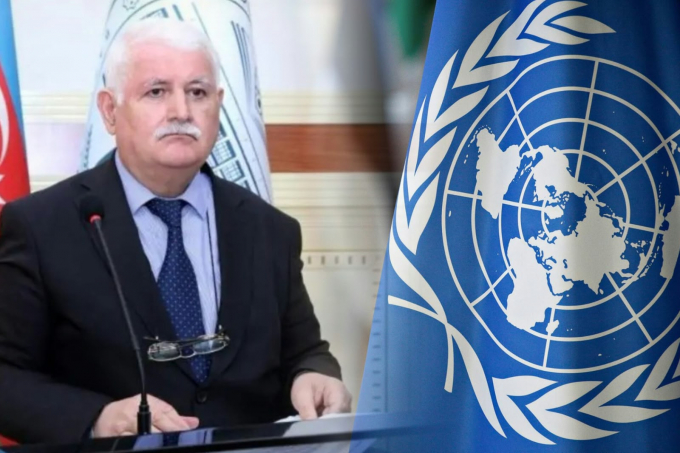
The Committee included several important issues raised in the alternative report submitted by the International Eurasia Press Fund (IEPF) to the UN Committee on Enforced Disappearances in its concluding observations and recommendations on Armenia.
IEPF President Umud Mirzayev made this statement while commenting on the final document adopted by the UN Committee on Enforced Disappearances on additional information provided by Armenia.
Umud Mirzayev noted that a comparison of the Committee's final document dated September 24, 2026, with the alternative report submitted by IEPF and the issues raised by Azerbaijani civil society representatives in Geneva reveals important conclusions:
"For us, the main issue was not just the publication of the alternative report on the UN platform. Our goal was to bring the fate of Azerbaijanis, especially children, whose fate has remained unknown for decades, back to the agenda of international law and to achieve that concrete questions are raised before Armenia. In this regard, the provisions contained in the final document of the Committee are very important."
The IEPF President said that the Fund's alternative report focused on Azerbaijani citizens who were taken prisoner and hostage during the First Karabakh War and whose fate remained unknown, especially 71 children registered as missing. The report raised the issues of determining the fate of these individuals, investigating possible cases of enforced disappearance, disclosing information about mass graves, identifying human remains, and Armenia's cooperation with Azerbaijan.
The IEPF report and its annex are registered in the official UN database under the numbers INT/CED/NGO/ARM/69875 and INT/CED/NGO/ARM/69876, respectively.
According to Umud Mirzayev, it is particularly important that the Committee's final document reflects these issues in several key areas.
The Committee expresses concern at the lack of progress in investigating and prosecuting allegations of enforced disappearances of military personnel and civilians, including women and children, in the context of the Karabakh conflict. It recommends that Armenia thoroughly, effectively and impartially investigate all such allegations, regardless of the time, place and circumstances of the incident, even in the absence of a formal complaint.
The document also includes issues such as bringing the alleged perpetrators to justice regardless of their nationality, continuing the search and investigation until the fate of the missing person is determined, and regularly informing families about the process.
Umud Mirzayev said that he considers the Committee's position on mass graves to be particularly important:
"One of the noteworthy points is that the final document refers to the data of the State Commission on Prisoners of War, Missing and Hostages of Azerbaijan, and notes that 32 mass graves have been discovered in the liberated territories. The Committee also recommends accelerating the process of finding and identifying human remains, identifying new burial sites, and investigating existing cemeteries. It also states that the argument of protecting state secrets should not hinder the search for missing persons and the identification of human remains."
The IEPF President emphasized that one of the important directions of the final document is related to direct cooperation between Azerbaijan and Armenia. The Committee recommends strengthening the exchange of information and evidence between the two countries, expanding cooperation between relevant state commissions, prosecutors' offices and law enforcement agencies.
In addition, the recommendations include establishing an anonymous reporting mechanism to identify the location of existing cemeteries, strengthening cooperation in the search, recovery and identification of human remains, and considering the possibility of establishing a joint technical mechanism with the participation of independent forensic experts, archaeologists and other specialists from Azerbaijan and Armenia.
Umud Mirzayev said that serious and long-term preparatory work stands behind the achieved result:
"While preparing the alternative report, we cooperated very effectively with the State Commission on Prisoners of War, Missing and Hostage Citizens of Azerbaijan. This cooperation was of great importance in the accuracy of the factual basis of the report, the systematization of information on missing persons, children, mass graves and the identification work carried out. I believe that one of the main reasons for the fruitfulness of our work in Geneva was this correct model of cooperation established between the state body and civil society."
The IEPF President also emphasized that it would be incorrect to present the results as the work of only one organization. He noted that within the framework of the 31st session of the UN Committee on Enforced Disappearances, other Azerbaijani civil society organizations and representatives also actively participated in the process, provided alternative information and made a significant contribution to conveying a joint position to the members of the Committee.
"The work we did in Geneva was the result of true teamwork. I would like to especially note the work of our colleague Sahib Mammadov, who has been working here for many years in the field of human rights protection and civil society. His professional approach based on many years of experience, his active participation in the preparation of documents and his work with the members of the Committee in Geneva made a significant contribution to our overall activity. At the same time, the materials prepared by our other colleagues, our joint statement, meetings with the members of the Committee and the issues addressed to the Armenian delegation complemented each other. Each of our colleagues contributed to this result. The main achievement is that the humanitarian problems raised by Azerbaijani civil society for many years were expressed in the form of specific questions and recommendations at the UN level."
Umud Mirzayev stressed the importance of the issue of children. According to him, the most painful part of the IEPF alternative report is related to the fate of 71 Azerbaijani children who were under the age of 18 at the time of their disappearance. Although the number of 71 children is not specified in the final document of the committee, allegations of enforced disappearances of children in the context of the Karabakh conflict are mentioned, and children who have been victims of enforced disappearances are considered a particularly vulnerable group.
"We do not see this issue as just a statistic from a past war. Behind every missing person is a family that has been waiting for answers for decades. Determining the fate of children in particular is a humanitarian and moral responsibility. If Azerbaijan and Armenia are to move towards peace, healing the open humanitarian wounds of the war must be an integral part of this process," said the IEPF president.
Umud Mirzayev added that the Committee's final document also identifies important areas of action for the coming period. Armenia should provide the Committee with updated information on the implementation of the recommendations, and civil society should continue to participate in monitoring this process.
"For us, the Geneva process is not over. The main issue is not that the recommendations remain on paper, but that they are implemented. IEPF, together with other civil society organizations and partners, will continue to consistently keep the issue of determining the fate of missing Azerbaijanis, especially children, on the agenda at international platforms," said Umud Mirzayev.